What virtual reality does brilliantly in a primary classroom
Standing at the base of a pyramid does something to a class that a picture of one never will. What a headset is genuinely brilliant at, and how a VR session runs in a primary school.
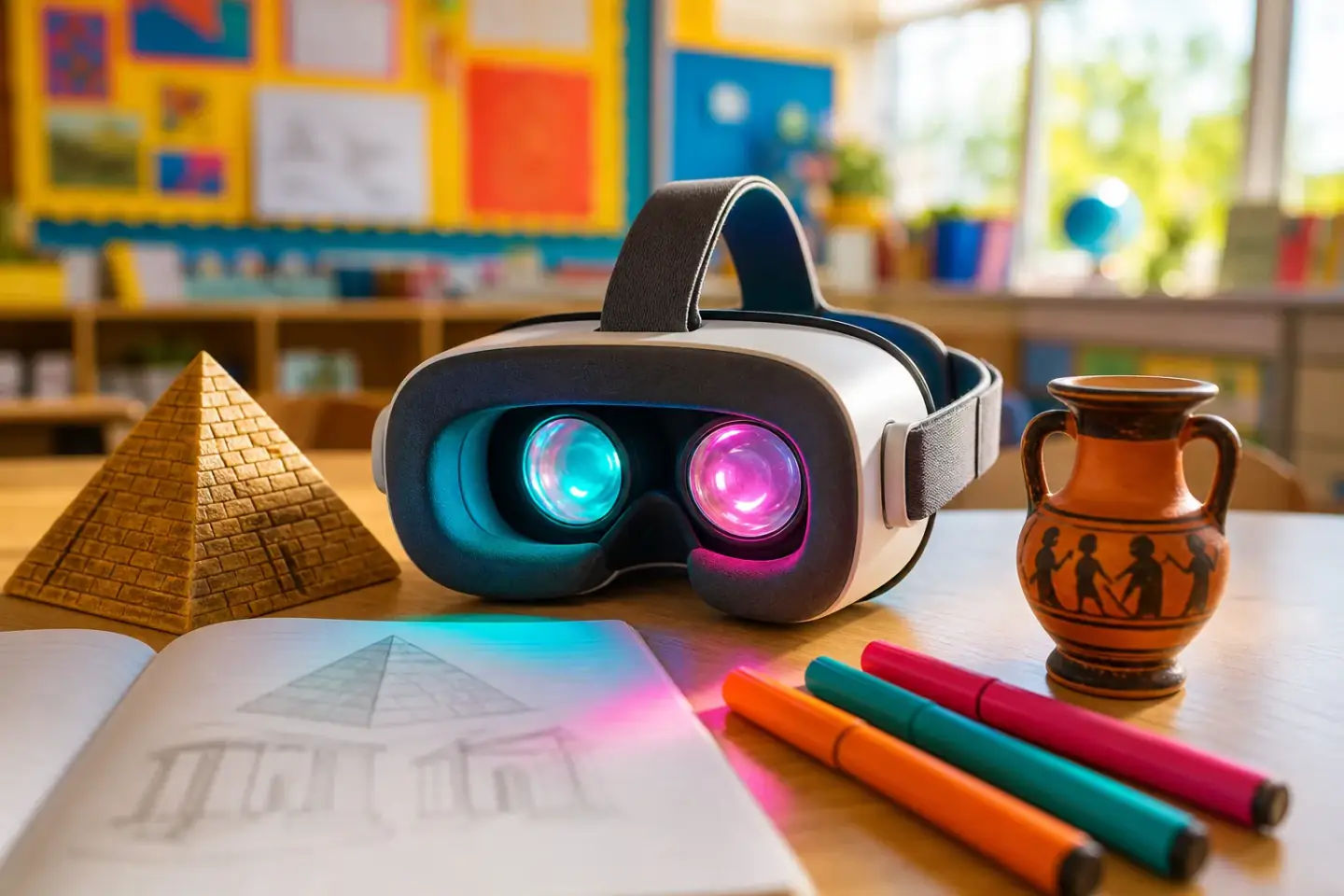
A pyramid in a textbook is a triangle on a page. A pyramid you have to tilt your head back to see the top of is something else entirely, and the pupils who have done that write about ancient Egypt differently afterwards. That is the case for virtual reality in a primary school, and it is a strong one: a headset gives a class scale, place and presence that no book, film or model can, and it gives it to every child in the room at the same moment.
What a headset gives a class that nothing else can
Scale first. Height, distance and width are abstractions on a page, and no amount of comparing something to double-decker buses fixes that. Standing at the foot of a column, looking down the length of a temple or across a river gives pupils a physical sense of size, and the numbers they were given last week suddenly mean something. Teachers notice it in the writing that follows: the description gets specific.
Then how a place fits together. Pupils who have walked from a market to a temple to a theatre carry those in an order and a geography that a labelled plan never gives them. And presence — pupils behave as though they are somewhere, which produces exactly the sort of question a teacher cannot manufacture. When the whole class goes in together, the effect is stronger again: the reactions are shared, and the conversation afterwards has one reference point rather than thirty.
How the session actually runs
The technology is the easy part. What makes a VR session teach rather than entertain is the teaching built around it, and that is where the planning goes.
- The whole class goes in together. Nobody sits watching twenty others have a turn.
- A facilitator teaches from inside the experience, pointing pupils at what to look for and asking questions while they are standing in the place.
- Every scene is built around standing still and looking around rather than flying pupils through space, which is what keeps it comfortable.
- The session lands in a unit, not beside one — early to generate questions, or later to consolidate what pupils already half know.
- Follow-up resources come with it, so the lesson after the headsets come off is already planned.
The questions schools ask
Comfort comes up first, and it has a straightforward answer. Motion sickness is caused by movement the body cannot feel, so experiences designed around standing and looking are far more comfortable than ones that move pupils through space — and a pupil can stop and lift the headset at any moment. We offer sitting out to everybody before the first headset is handed over, which makes it unremarkable for the one or two in a class who would rather watch.
Hygiene is a fair question about equipment that sits on thirty faces in a morning, and the answer is that headsets are wiped between classes as part of the changeover, by our team rather than yours. The headsets fit over glasses, so nobody is excluded.
Screen time worries schools more than it should. A twenty to thirty minute session sits inside a normal teaching day and displaces nothing that matters. Our sessions run on hardware chosen for classroom use, we bring the age guidance in writing with the risk assessment, and staff keep the final say on any pupil.
Retention is the one that decides whether the day was worth it, and here VR does well: pupils remember having been somewhere for years. Turning that memory into knowledge is the job of the lesson afterwards, which is why the follow-up work matters as much as the headsets and why it comes as part of the booking rather than as an afterthought.
Where it earns its place
Use a headset for what it is unusually good at and surround it with ordinary good teaching, and it earns its half-day easily. Pupils who have stood inside a place ask better questions about it, and those questions are worth more than another double page of the textbook.
Awe is where the learning starts. The proof of a VR session is what pupils write in the lesson after it — and that is the part we plan with you.
We run four VR sessions for primary schools: Ancient Egypt, Ancient Greece, Ancient China and Indigenous Australia. Each comes with the kit, a facilitator teaching from inside the experience, curriculum links for your key stages and classroom resources for the week afterwards — as a half day or a full day, so every class gets a turn.