
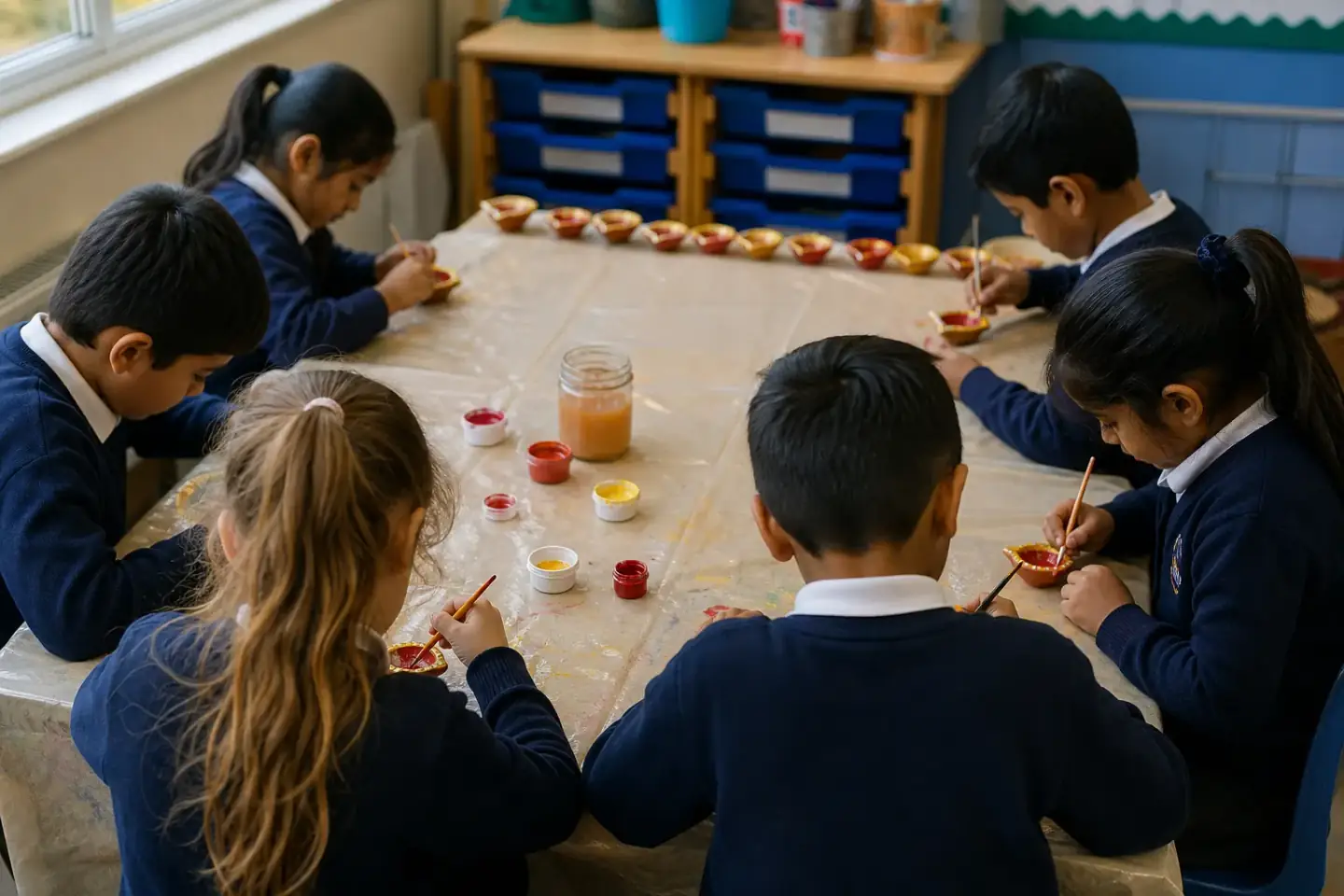
Oct / Nov · Diwali
Diya Painting
Add your personal touch to the festival with a creative diya painting experience.
- Key stages
- EYFS to KS2
- Session length
- 60–90 minutes per class
- Group size
- Up to 30 pupils per session
- Formats
- Single class, year-group carousel or full day
How the session runs
Introduction
What a diya is for
The facilitator explains what the children are holding: a tealight holder used at Diwali, the Festival of Light, sacred in Hindu, Sikh and Buddhist practice. Diyas symbolise goodness and purity, and lighting one is understood to dispel darkness, evil and greed from the household — good over evil, especially on the day of Diwali.
The inside
Where the tealight sits
The first coat goes inside the lamp, in a single colour, because that is where the tealight will sit. Pupils learn how to change colour properly as they go — a gentle rinse in water, then dried on the cloth or kitchen towel at their place — which keeps the colours clean for everything that follows.
The outside
Turn it over and paint
The lamp is turned over and the outside painted in different colours. The facilitator works step by step through this stage, because the painting itself does not take long and the real skill is keeping thirty pairs of hands off wet paint while it dries.
The pattern
Dots around the rim
Once the outside is covered, pupils use the wrong end of the brush to dot a pattern around the top edge of the lamp, picking colours that answer the ones already down. It is the stage that turns a painted pot into something that looks finished.
The gems
Five or six each
When the lamps are dry, every pupil is given five or six little gems to stick around the outside edge. Small enough to be quick, and enough to catch the light once a tealight is in.
Drying
Left somewhere safe
The finished diyas are carried carefully to a flat surface and left to dry for at least half an hour before anybody handles them again — so a shelf or windowsill out of the way is the one thing we ask you to have ready.
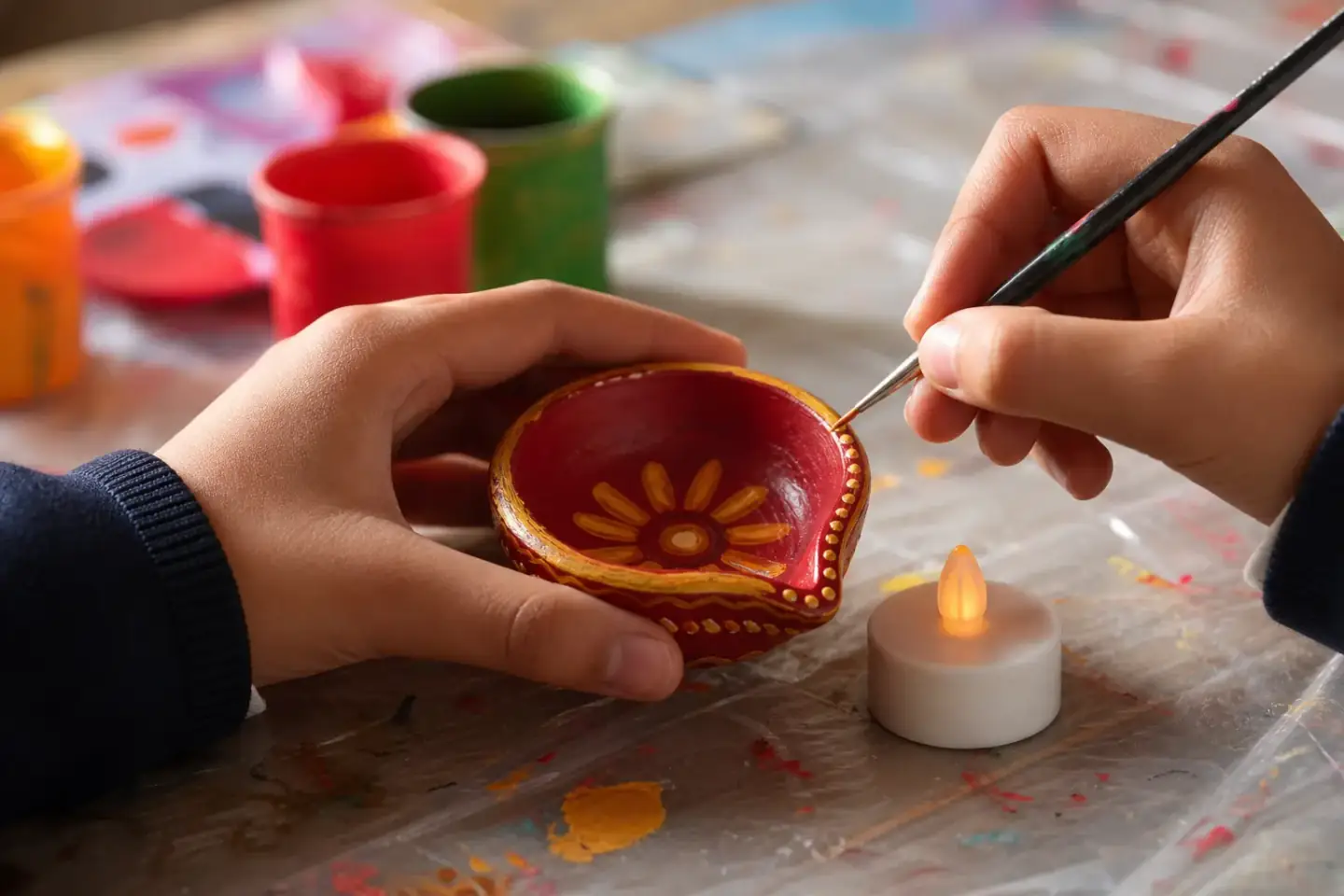
It is a lamp painted inside first, because that is where the tealight sits.
What pupils will learn
- What a diya is: a tealight holder used at Diwali, the Festival of Light
- Why the lamp holds sacred prominence in Hindu, Sikh and Buddhist practice
- That diyas symbolise goodness and purity, and that lighting one is understood to dispel darkness, evil and greed from a household
- That the lighting of a diya represents good over evil, especially on the day of Diwali itself
- Painting a porous, curved surface in a sensible order — inside first, then outside, then the detail
- Brush care: rinsing gently and drying on a cloth so the next colour stays clean
- Using the wrong end of the brush to dot a pattern that answers the colours already used
- Patience with a wet object, and the care needed to carry it to dry without spoiling it
Curriculum links
EYFS to KS2
- Art and Design, KS1
- Use a range of materials creatively to design and make a product, developing technique in colour, pattern, line and form.
- Art and Design, KS2
- Improve mastery of painting technique on a curved, porous surface, working in a considered order from base colour to fine detail.
- RE, agreed syllabus
- Symbols and festivals: why light carries meaning at Diwali, what a diya is understood to dispel, and why the same lamp holds sacred prominence in Hindu, Sikh and Buddhist practice.
- PSHE and citizenship
- Recognising the traditions present in their own class, and comparing family practice respectfully and without ranking it.
- British Values
- Tolerance of those with different faiths and beliefs, taught through a real household object rather than a description of one.
What we bring
- A real terracotta diya for every pupil, with spares for breakages
- Paints, brushes, pencils and little gems — five or six per pupil
- Tablecloths to cover every surface pupils paint on, plus cloths and kitchen roll for cleaning brushes
- Water cups, set within arm's reach of every group
- An apron for every child, handed to the organiser at the start of the day
- A DBS-checked facilitator who explains what the lamp is for before any of it is painted
What we need from you
- Tables set out for groups of around six, and floor covering if the room is carpeted
- Pupils arriving with sleeves rolled up, ready to put an apron on
- A sink in the room, or clean water for refilling the cups between classes
- The class teacher with the group throughout — we are never left alone with pupils
- Twenty minutes before the first session to cover surfaces and lay the lamps out
- A flat shelf or windowsill where thirty diyas can sit undisturbed for half an hour or more
When to book
Oct / Nov
Diwali follows the lunar calendar and typically falls in October or November. Exact dates change each year — we'll confirm the nearest date when you book.
Reviews for our workshop team
What schools say about our Diwali workshops
“Highly recommend the African mask workshop! It's one of the highlights of the Year 5 calendar. Well worth every penny”
Joanne Netto “What a great experience for the children! Ivan was amazing at keeping their interest and making the drumming session as active and exciting as possible.”
Demelza Jones “A great workshop. Fantastic resources and Chris was great with the children. They were engaged throughout and talked about it for ages afterwards. This is the third time we have used them and they never disappoint!”
Julie Gill “Fantastic workshops for primary school children - the facilitators Emma for African drumming and Naomi for dance workshops were friendly, skilled and provided a very enjoyable experience for the children. Thank you!”
Aleksandra Dass “We have had a number of experiences from the Education Group and are always impressed by the quality of the workshops. We return to them time after time because we know that the planning, content and age-appropriateness of their sessions are absolutely right for the children.”
Kate Baguley “Our infant school aged pupils enjoyed the Maypole experience and were amazed to see the maypole in the middle of their playground. The teacher was fantastic with our young children and we all managed to come away from our sessions feeling we had learnt something rather wonderful!”
St Peter's
Questions schools ask
Can pupils take the diya home the same day?
Yes, as long as there is somewhere flat for the lamps to dry for half an hour or more after the session. They are dry to the touch well before home time.
Is anything actually set alight in school?
No. Nothing is lit during the session — pupils learn what the lamp is for and what lighting it means, and what happens at home afterwards is the family's choice.
We are booking this for Holi — what changes?
The lamp and the method are the same; the facilitator frames it for the day you have booked. If you want the colour itself, that is a separate kit you order and your own staff run outdoors — plenty of schools take the painting in the morning and the colour run on the field after lunch.
We are booking this for 21 May — what changes?
The lamp is studied out of season, which is the point: pupils learn what it means to the communities who light it, and the facilitator sets that beside the ways other families in the room mark an occasion with light.
Will pupils be asked to talk about their own family's traditions?
They are invited to, never required. The facilitator asks the room rather than picking on individuals, and a pupil who would rather just paint is left to paint. Nobody is appointed spokesperson for a culture.
How much mess should we expect?
Less than a wet clay session. We cover the tables ourselves, bring an apron for every child, work six to a table and clear everything before we leave. Sleeves rolled up before they sit down is all we ask of the class.
Does this hold up for upper KS2?
Yes, with ninety minutes rather than sixty. Year 5 and 6 groups do more ambitious work on the outside colours and the dotted pattern, take more care over the gem work, and take on the discussion about what the festival means to the families who keep it.
The other Diwali sessions
All of Diwali
Add your personal touch to the festival with a creative diya painting experience.
Tell us the date you have in mind and we'll come back within one working day with options for your school.